Gemma 4 - one of the hottest things in AI right now
Listen, if you’re looking for the "next big thing" in open AI, you’re looking at it. Gemma 4 just dropped from Google DeepMind, and it’s not just a marginal upgrade—it’s a power move. It’s built on the same research foundation as Gemini 3, but it’s lean, mean, and ready to run on everything from a smartphone to a high-end workstation.
4/8/20262 min read
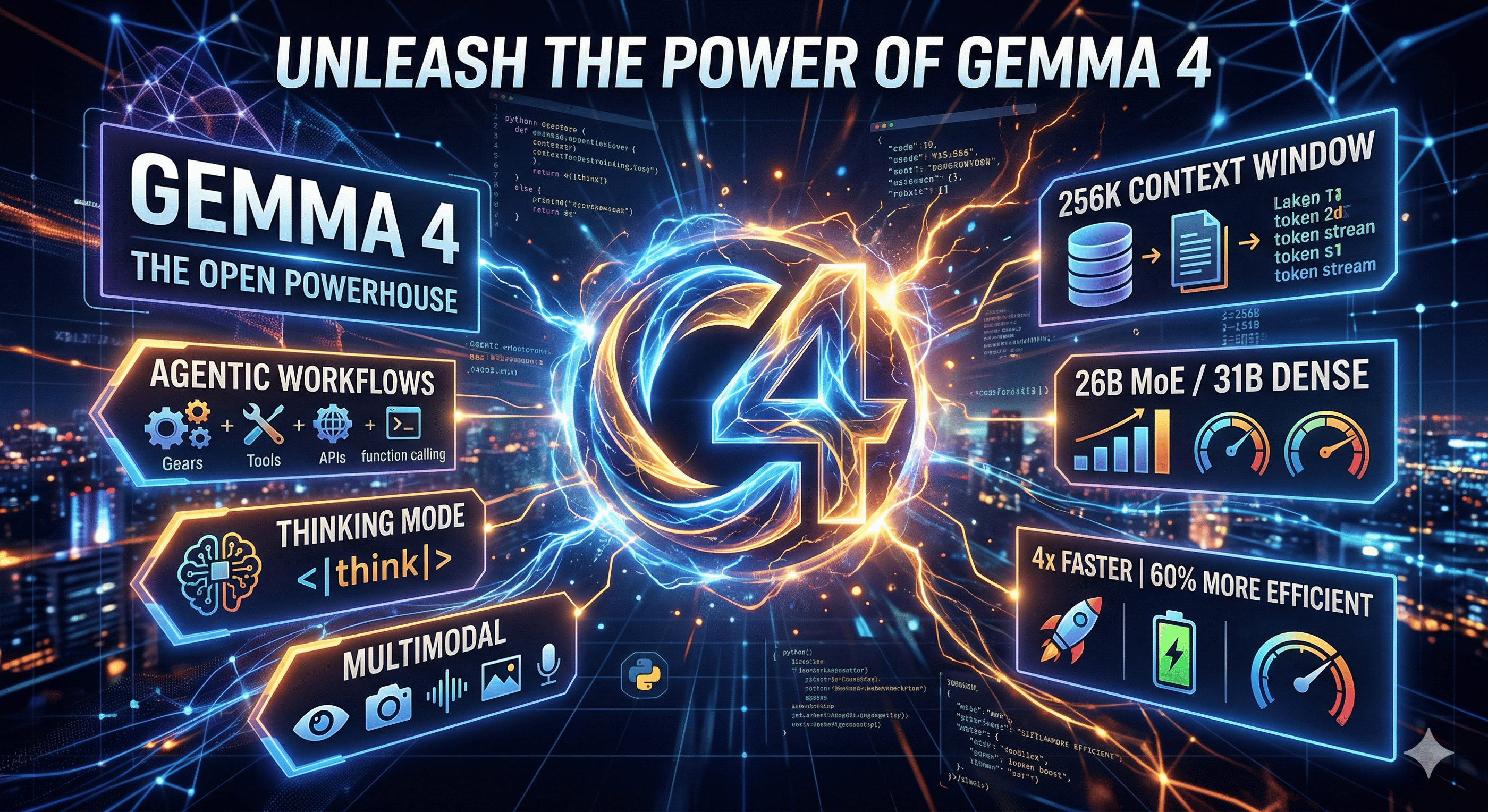
Listen, if you’re looking for the "next big thing" in open AI, you’re looking at it. Gemma 4 just dropped from Google DeepMind, and it’s not just a marginal upgrade—it’s a power move. It’s built on the same research foundation as Gemini 3, but it’s lean, mean, and ready to run on everything from a smartphone to a high-end workstation.
Here is the high-energy, low-friction breakdown you need.
🚀 Gemma 4: The Cliff Notes
The Lineup: Four main flavors—E2B (Edge 2B), E4B (Edge 4B), 26B MoE (Mixture-of-Experts), and the heavy-hitting 31B Dense model.
The Brain Power: Frontier-level reasoning. It ranks #3 globally among open models on the Arena AI leaderboard.
Multimodal by Design: It doesn’t just "read" text; it natively understands images and audio right out of the box.
Context for Days: Supports massive context windows from 128K up to 256K tokens. You can feed it entire codebases or 500-page manuals without it breaking a sweat.
Business Ready: Released under a commercially permissive license (Apache 2.0), making it a goldmine for developers building proprietary products.
Speed & Efficiency: Up to 4x faster and 60% more battery-efficient than its predecessor, thanks to new architecture like Shared KV Caches.
🛠️ The Detailed Look: Features that Matter
1. Thinking Mode (The Reasoning Engine)
Gemma 4 introduces a native "Thinking" mode. By using specific <|think|> tokens, the model can perform internal chain-of-thought reasoning before giving you an answer. This isn't just a gimmick; it’s the difference between a model that "guesses" and a model that "solves." Whether it's complex Python debugging or high-level strategic planning, it shows its work and delivers higher accuracy.
2. Mixture-of-Experts (MoE) Architecture
The 26B MoE variant is the business MVP. While it has 26 billion total parameters, it only "activates" about 4 billion at any given time.
The Result: You get the "smartness" of a massive model with the lightning-fast speed and low cost of a small one. It’s about intelligence per parameter, and this model wins that game handily.
3. Agentic Workflows (Built to Do, Not Just Say)
Google has paired Gemma 4 with an Agent Development Kit (ADK). It has native support for:
Function Calling: It can trigger external tools and APIs.
Structured Output: It outputs perfect JSON every time, which is critical if you're building an app that needs to talk to other software.
Tool Use: It can navigate files and execute code locally, making it a "doer" for autonomous tasks.
4. Native Multimodality
Unlike older models that "bolted on" vision, Gemma 4 is multimodally native. It uses a new vision encoder that handles variable aspect ratios—so it doesn't crop or distort your images. It can "look" at a chart, "hear" an audio clip of a meeting, and then write a text summary that connects the two.
5. Multilingual & Global Reach
It’s fluent in over 140 languages. For anyone looking to scale a business globally without the massive overhead of translation APIs, this is a massive competitive advantage. It understands nuance, slang, and cultural context better than almost any other open model in its size class.
Bottom line: This isn't just tech for the sake of tech. This is a tool you can use to build, scale, and dominate. If you have 8GB to 24GB of VRAM, you can run these locally today and keep your data private while getting GPT-4 level performance.
Knowledge isn't power—execution is. You have the specs, you have the speed, and you have the capability. Now, what are you going to build with it? Call me today to discuss your project idea and let’s pressure-test it.